Saturday, November 26, 2005

One of The Best Thanksgivings Ever


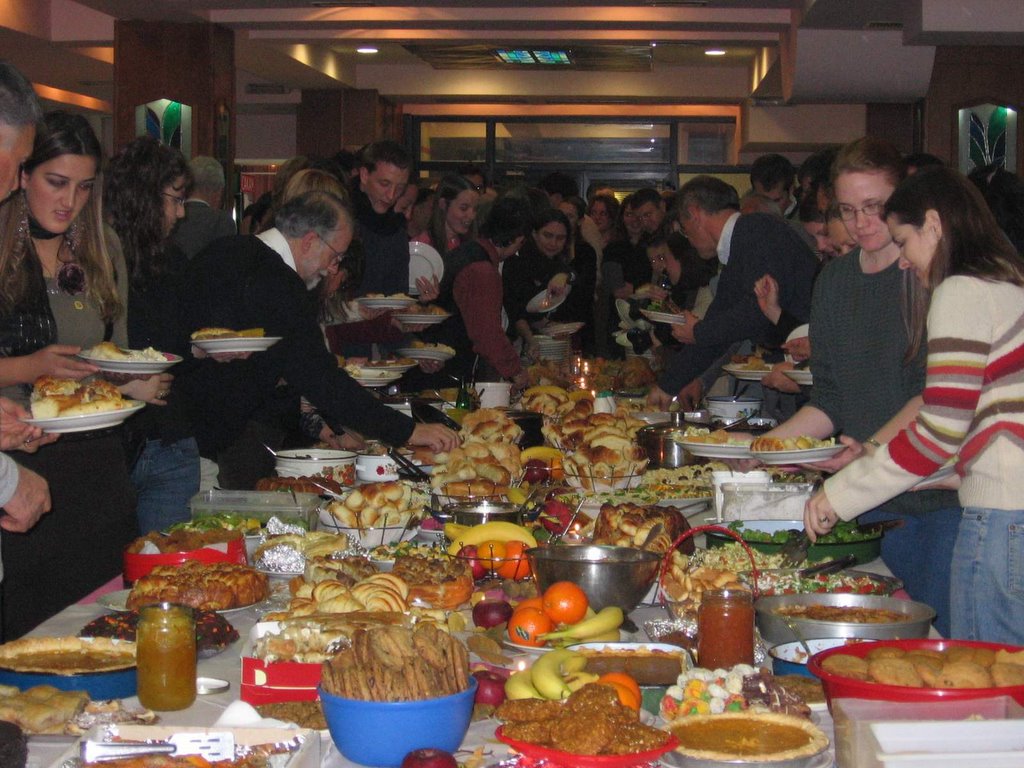
Celebrating Thanksgiving has been a beloved tradition for PC in Macedonia, with a big Thanksgiving dinner for all the staff, current volunteers, trainees and their host families. It was a real festive occasion; there were probably about 200 people in attendance (with about 70 volunteers & trainees currently serving in Macedonia). It was held at a nice restaurant in Veles, all the families and volunteers brought food. Peace Corps provided the turkeys (15 total, shipped over from the US). My host mom made mashed potatoes (purée kompiree), baked tikva (pumpkins) and a kind of cornbread. She wouldn’t allow me to help with the cooking. However, I did help with the decorating and setting up at the restaurant. We took pumpkins from my family’s garden for decoration, as well as dry leaves and flowers.
First our country director got up and said a few words. Then my friend Erika and I gave brief speeches about what Thanksgiving is and the history behind it. Erika gave hers in Albanian and mine was in Macedonian. We both read our speeches that were written with the help from our language teachers. It was the first time that I had heard Albanian spoken, Erika did an amazing job, the language is very melodic, it reminded me a little of French! When I gave my speech, I was nervous, but it went well and I was glad I did it. Then Sara W. (another trainee) gave a short, touching and humorous speech about things we are grateful for, including the hospitality of our host families, the assistance from the PC staff, as well as the support and love from our families and friends back in the US…oh yeah, and letters & packages from them too!
Then the dinner began, which was buffet style. One of the restaurant staff carved the turkeys. There was an incredible amount of food there; the table was packed and the dishes were almost overlapping each other, so there was plenty of food for everyone. Both Macedonian and American food were present (some people got creative with making things like stuffing and apple pie with the ingredients that were available). The only common staple missing were cranberries (not available here). There was also raijka (“rock-eeah”), liquor made from grapes, and plenty of “sok” (sodas).
The program continued after dinner with a group of us trainees leading a rendition of “America, the Beautiful”, and trainees from Negotino giving a short skit of a typical Thanksgiving day in the states (including pie-making and football watching). Then the group from Chaska led the traditional Macedonian dance “The Oro” (which is A LOT like Greek dancing; a little like line dancing, but slower, holding hands, stepping and leg swinging in unison). This was one of my favorite moments of the evening. There were perhaps 150 people, Macedonians and Albanians, Volunteers and Staff, young and old, people of all ages, backgrounds, ethnicities, skin color, languages and gender smiling and laughing over a universal custom: dancing and making merry.
After returning home, I shared the photos and stories with my host grandmother (There was a limited number of people allowed to attend). Then my host brother and two of his friends/cousins arrived. One of them brought out an accordion and the party continued in the small living room with dancing and music! I laughed, danced and, of course, took photographs. Overall, it was a fantastic evening.
This has had to be one of the best Thanksgivings I’ve ever had. The only thing I would’ve changed is to have had my family back home in the US to share it with!

Wednesday, November 23, 2005

A little more about Macedonian culture & some other websites...


Macedonian Culture

Promaya: a draft. There is a prevalent belief in this culture that sitting in a draft will get you sick.

Over indulgence of children, yet physical discipline, like slapping is tolerated.

Students are responsible for their education, not parents or the teachers. The teacher’s responsibility is to cover the curriculum (which has been mandated by the government).

Preferring never to be alone

Wearing or using each other’s clothes and possessions (between family members)

Always offering food or drink to everyone present

Freely commenting on each other’s personal appearance

Viewing older people as family leaders

Giving an odd number of flowers except for occasions of mourning

Wearing black clothes for one year after the death of a close family member

Asking pointed questions about how much money someone makes, how much personal property/possessions cost.

Hospitality:
Guests are treated like royalty here. My family treats me like a guest. They insist that I not lift a finger to help around the house (although I try at times), my host mom does my laundry. Food is a big deal here. My host family is constantly shoving food at me, even after I have said several times that I am full. If I am not paying attention, they will give me a larger portion of food than I can physically eat. They are confused by the fact that I don’t eat bread (because apparently everyone in Macedonia eats bread). If I don’t eat enough food to their liking, they think that I didn’t like it, that their must be something wrong with it.

Volunteering:
This concept hasn't really caught on in this culture. People often don't understand why someone would want to volunteer. Sometimes people are suspicious as to why we PC Volunteers come to their country, occasionally they suspect we are spies for the US government. Sometimes I am asked for the real reason why I am in Macedonia. I've written an essay about this and will post it here very soon.

WEBSITES:
Sometime soon I will create links for the following websites, however I don't have much time to figure out how to do so...until that time, here they are:

Other BLOGS from PCV's/PCT's in Macedonia:

http://sararish.blogspot.com
http://lizabbett.blogspot.com/
http://www.adamanddanielle.com/
http://www.travelpod.com/travel-blog-entries/darcieswein/macedonia-pst/1099750560/tpod.html

Info about Macedonia:

http://www.lonelyplanet.com/worldguide/destinations/europe
http://www.macedonia.org/
http://faq.macedonia.org/

Sunday, November 20, 2005

Visiting Kochani

On Tuesday Nov. 15th we met our counterparts in Veles. My counterpart’s name is Ljubica (“Loobeetsa”); she is a teacher with 15 years experience and does not hesitate to speak her mind. The good thing is that she has some previous experience with the “Pees Korpz” and Ljubica seems to be very receptive to working and team teaching with me, for which I’m grateful for. I quickly got on her good side; she was especially pleased to learn that I like coffee with sugar.

I must mention here that smoking cigarettes is extremely prevalent. The entire school staff smoke, including the headmaster and the teachers lounge is like a chimney. Second-hand smoke is an inevitable health hazard in this country (with upper respiratory infections being the most common health issue).

On Wednesday I met Ljubica at the hotel and then we caught a bus to Kochani (for about $4 one-way). Everyone has told me that Kochani is a very pretty city, and they were right. In a little less than 2 hours we arrived. First we went to the school where I’ll be working, and I met most of the staff. It was a whirlwind of names and faces. My three days visiting Kochani were full of meeting people, being stuffed full of more tasty, fattening Macedonian meals, visiting numerous classrooms, introducing myself to students and touring the small city. It was also nice to meet the currently serving volunteers in and near Kochani. Unfortunately one of them is COS'ing (Close of Service) and will have left by the time I move there. However she was a wealth of great info and advice. I now know where to buy tofu and dried fruit, eat great pizza, get cheap CD’s and DVD’s as well as visit the local mosque and buy a guitar!

I am ready for my training to be over, but I still have one more month to go. I will be glad to finally move to my city and have my own apartment. Training is hard for many reasons, but one of them is living with a host family and not having that much privacy or independence. I love my family, I know they mean well, but they treat me like a little kid, they even put (too much) sugar in my coffee for me, as if I was incapable of doing it myself! I know it is just a cultural thing. Learning the language is tough too. I think I'll do better when I work with a private tutor. Talking with the other volunteers after returning to site visit makes me realize we are all kind of burned out from training and language lessons. It’s nice to know that I’m not the only one.

Oh, and I just bought a copy of the first Harry Potter book in Macedonian! I’m going to try to read it too, but it’ll be slow going for now. Hopefully it will be a good motivator to keep at my language learning!

P.S. Some people have asked about Thanksgiving...obviously it is not celebrated here, but the Peace Corps is going to have a HUGE Thanksgiving dinner for us (15 turkeys have been shipped over from the states) and we will also have entertainment. All of the PC staff and volunteers will be there, including our host families. They project 200 people will attend.

Tuesday, November 15, 2005

Before the Rain

I just watched the movie “Before the Rain” directed by Milcho Manchevski, a Macedonian film, 1994, which won tons of awards including a Academy Award nomination in ‘95 for Best Foreign Language Film.

I was really impressed. This is a movie more Americans need to see. Keeping in mind that it has an "R" rating, and is pretty graphic at times, it is thought provoking and very well done. It may be hard to find, but I encourage you to see it if you can. “Scarecrow video” in Seattle specializes in movies like this.

Of course I am feeling pretty naïve at this point about all of the politics and history involved in this region of former Yugoslavia. Pretty naïve indeed. We are encouraged not to talk about politics, at least until we have been here longer, have a better grasp of the language and are more familiar with the situation.

The tension between Albanians and Macedonians is omnipresent. There is a monument in the middle of my village to a single Macedonian soldier that was killed by an Albanian in the recent (2001) conflict. When I learned that, I got a little more insight into why there is a lot of anger and tension against Albanians.

There are no easy answers, there are no winners. Healing and closure feel like a long ways away.
Like right now, the fact that Macedonia is struggling with the current situation in Kosovo, which I don’t even really know much about other than the fact that Americans are strongly encouraged not to go there right now, and this country is also still bickering with Greece over their official name…Greece has issues with them using the name of Macedonia so, to placate their NATO neighbor, the country name is currently “Former Yugoslavic Republic of Macedonia”.

Of course I am forming my own opinions…however, I will not try to sway you, the reader, at this time. With the Peace Corps encouragement…I am still very much an observer, quietly listening and learning more about the history and politics before I tiptoe into politically heated debates and discussion.

In the meantime, go check out the movie “Before the Rain”…

P.S. There is a sequel as well, “Dust” (2001)

Saturday, November 12, 2005

My future home in Macedonia...

Thursday I got out of the house for the first time so that I could go to the meeting to learn about site announcements. They took us trainees in one at a time. Todd got Negotino, Marita and Shauna are both near Lake Ohrid, probably the most beautiful region of the country, Lindsay is in the large city of Kumanovo and I am in the city of Kochani.

Overall, I am happy with my site, although I think I would’ve liked a larger city. Kochani is approx 33,000 and the school I’ll be working at also has some Roma kids, so I’m glad about that. There is also another current PCV in this town, Marilyn, who is working with an NGO to help the Roma population, which I’m excited about. I’m also not that far from Stip, which is where Rachel, a Mac 8 who’s extended for a third year, lives and teaches at a high school.

My guide book says there’s not much about the town of Kochani, but a couple things of interest to me is that there are some hot springs nearby, as well as some ancient roman ruins and is near to the ancient Roman Road “Diagonal way” which connected Stobi to Bulgaria.

Also I've been told that this is a beautiful part of the country and that there are some nice hikes in the area. It is roughly 2 hours away from the capital of Skopje.

Next week we will all be meet our counterparts and visit our future sites for 3 days.

“There is not much in the town itself as, until communist industrialization, it had mostly been a farming settlement since the time of Aleksander III of Macedon. Around 330 BC, Aleksandar brought back rice from India, which was planted in these fertile fields. The ancient paddy fields are still worked today, many by hand, and they provide most of Macedonia’s rice.”

--The Bradt Guide to Macedonia by Thammy Evans.

Friday, November 11, 2005

Sick and Smothered

Let me first preface this by saying that I love my host family and they are sweet people with good intentions.

So I’ve been sick for almost a week. I started feeling crummy last weekend when our group visited the trainees staying in the nearby community of Sveti Nickole (Saint Nickolas). That morning I had woken up to a sore throat. By that evening it turned into a headache as well. I ended up spending the entire day on Sunday in bed.

Superstitions are common in some cultures. In Macedonia, there is a common opinion that sitting in a draft, called “promaya”, will cause you to get sick. My family has a couple of ideas about what caused my illness. Mostly they blame the fact that I’ve been washing my hair in the AM and going out without drying it (an advantage to having short hair). They also blame Sveti Nickole and the fact that I drank cold soda when I was there. (I, of course, believe I got a virus because my immune system was down due to stress and not enough sleep).

By Monday I knew that I had a bad cold. I stayed in bed all day. My family became very concerned and tried to persuade me to call the doctor. I tried to explain (in my broken Macedonian) that I didn’t think it was necessary. I knew that the doctor would tell me to do all the things that I was doing already; resting, drinking liquids, taking aspirin, cough suppressants, etc (which fortunately are supplied in my medical kit). By Monday evening I gave into their insistence and called the Peace Corps medical doctor. I explained my symptoms and what I was doing to get better. She agreed with me and then spoke to my family to calm their nerves. Monday after lunch my family wanted me to stay downstairs with my baba (grandma) because it is warmer down in her room (thanks to a wood-burning stove) and it’s next to the outdoor bathroom. Of course, it’s also where everyone eats their meals, watches TV is and where all the guests “negosti” (visit). I ended up in the bed of my baba’s living room for the next two days. Although I could lie down and rest and I was being pampered like a small child, my family also kept waking me up every couple of hours to see how I was doing. They were frequently offering me coffee, tea, bread, vegetables, meat, and chocolates. I soon developed a runny noise and a bad cough.

Monday night I vomited so on Tuesday I stopped eating all foods and only drank water and tea. At this point my family acted as though I had something life-threatening. I tried to rest while my host dad watched football on TV. I declined all offers of food from them. I told them I just wanted to sleep. But I couldn’t sleep very well with my nose all stopped up and coughing all night. My baba was sick as well, and my host mom had three teeth pulled! (I suspect that once you have a bad tooth in this country, they just yank it out, which would explain why most of the old people don’t have many teeth left!). So here we were all feeling ill.

It was very interesting to me how there seemed to be no concept of what foods are best to feed a person who is sick. I was offered all kinds of foods that I know are not easy to digest. I did request eggs a couple of times, but that was about the only kind of “easily digestable” food I got. My sore throat longed for something cold to help the swelling; a cold drink, an ice cube or ice cream. But I knew I would get none of it. After three days one of my fellow trainees smuggled me a soda when she came to visit me, from my request, it was awesome.

At one point this week I vaguely remember six women entering the room, all sitting down to “negosti” and have tea. I could hear them clucking their tongues as they talked about me, how I was sick and not eating. They again offered me food and tea. I mumbled in Macedonian that I was tired and wanted to sleep. Then I remember one of the women standing over me, saying my name, practically wagging her finger at me, lecturing me in jumbled bunch of words about my being sick, that I should eat. I barely opened my eyes to look at her, I was so tired. Next thing you know my language teacher was above me calling my name. The women were gone. I learned later that she had driven them out. She stayed for a short while, talking with family and with me and I was so happy when she suggested I move back upstairs to my room. On Wednesday I had a house call from a Peace Corps doctor and nurse, which was nice. They were able to confirm that I didn’t have anything more serious than a viral infection, so no antibiotics were necessary. It was then that I learned that there were single-use strip thermometers in the medical kit, as well as some nasal decongestants. I was given some more cough drops and ibuprofen. They also gave my host family some peace of mind as well. I started to feel better mid-week, but it’s been a slow recovery.

Thursday, November 10, 2005

A lot happens during PST

A lot happens during PST (Pre-Service Training) that it is difficult to write about a “typical day”. However, during the week there is almost always language class for 3 to 4 hours a day and twice a week I have my student teaching in Veles (now always at 8am). At the end of training we will be tested on our Macedonian and are supposed to achieve an intermediate level. If we don’t pass the test then we will have a tutor once we go to our sites and have to re-take the test again later. They say that PST is the most stressful time of the PC experience, which I agree with, but I am also a little concerned about when we get plopped down at our sites and we won’t other trainees around to talk to, hang out or get support from. PST is for preparing us for that time. Fortunately we all will have a counterpart, which is a HCN (Host-country National) that will help us and work with us during our assignments at site. "Swearing in" is a big deal. For us, it is on December 16th. There will be a big ceremony and all the important people of Macedonia will be there, including the country president, the US ambassador (who will swear us in) and the mayor of Veles. All of our host families and counterparts will be there, as well as all of the PC staff. At that point we are official Peace Corps Volunteers. Immediately after Swearing in we will go to our sites. I forgot to mention that unfortunately one in our group has left us. Mike, from San Francisco, had to ET (Early Terminate) a couple weeks ago. He had to go back due to family obligations at home. While we are sad that Mike had to go (and most of us didn’t get a chance to say goodbye) it is a general consensus that it is better that he left now than later, after getting to site and being more invested in the community and work. Now our MAC 10 group has 32 trainees. Also, I must say that Macedonian kitchens are ‘magical’ places. The food here is very greasy and starchy, almost always cooked in vegetable oil. A big part of the diet is meat and vegetables. There is some fish, a lot of peppers, salt and sugar. I love the mountain tea here as well as the Mousaka, which I’ve had back home at the Greek restaurant I used to work at, although it is a bit different (cooked vegetables and meat). Also, something unique to this country is ajvar, which is like pureed peppers with tasty spices and then often laden on the plain bread and cheese that is like feta sprinkled on top. It is not too difficult to find a village baba (grandma) or mom stirring up a big vat of ajvar, or carefully peeling each individual pepper, a mound of discarded peels next to them. The other thing that makes them magical is that they frequently do not refridgerate their cooked food. They will store the dishes inside the oven (that is turned off) or in the cupboard and the food will not spoil. My personal theory is that there is too much sugar/oil/fat for it to go bad within a couple of days (because it usually gets eaten up within 2 or 3 days at most). The other volunteers prior to us told us this would happen and no one has gotten sick from the food yet due to this strange habit (it’s not that they don’t HAVE refridgerators, although they are considerably smaller than what we have in the states. Things like yogurt, wine, and milk are usually stored there). Also I should add that a lot of the women here, at least in the villages, make a lot of their own juices, jam and can a lot of fruit. Paulina, my host mom makes a mean apricot juice that is very sweet. Last weekend I went with my fellow village volunteers to another town, Sveti Nikole (Saint Nickolas). We saw a beautiful orthodox church and for the first time, I got to go inside a Macedonian church. It was fantastic, between 500-700 years old. It reminded me a lot of churches in South America, as well as in Greece; lots of frescos, paintings and icons of the saints. This town of approx 10 to 15,000 wasn’t even mentioned in my guide book. Our group from our village hung out with the five other volunteers in Sveti Nikole, they showed us around. There was a little park and plaza, a hill with a large cross on top and a nice view of the town. The previous Saturday the Sveti Nickole group had visited us in our village. We took them on a little hike up the side of the mountain where there’s a great view of Veles, then we went to each of our homes and “negosti’d”, getting stuffed on coffee, “sok” (juice or soda) chocolate sticks, slices of cheese and meat, as well as “slatko” or sickly sweet homemade deserts.
We had just had our site assessment interviews where we met with the program managers and gave some input into what we wanted in terms of our future site and program for the next 2 years. I inquired about the position working with Roma kids near Skopje, but they disappointed me by really talking it down. I let it be known that I was most interested in being in a city the size of Veles (30,000) or bigger and that I wanted to work with Roma kids, either as a primary or secondary assignment. Having previously only been to Veles and my little nearby village I worried about what kind of town I was going to end up in. Rumor had it that our group (Mac 10) was going to be primarily placed in small villages. Once seeing Sveti Nickole, a community smaller than what I would prefer, I realized that even if I got a town this small, I could probably handle it. It didn’t even feel that small. There were the standard things, a post office, market, plaza, coffee shops and restaurants as well as a movie theater (that functions once a week). So it gave me peace of mind about my placement.

Friday, November 04, 2005

More photos!


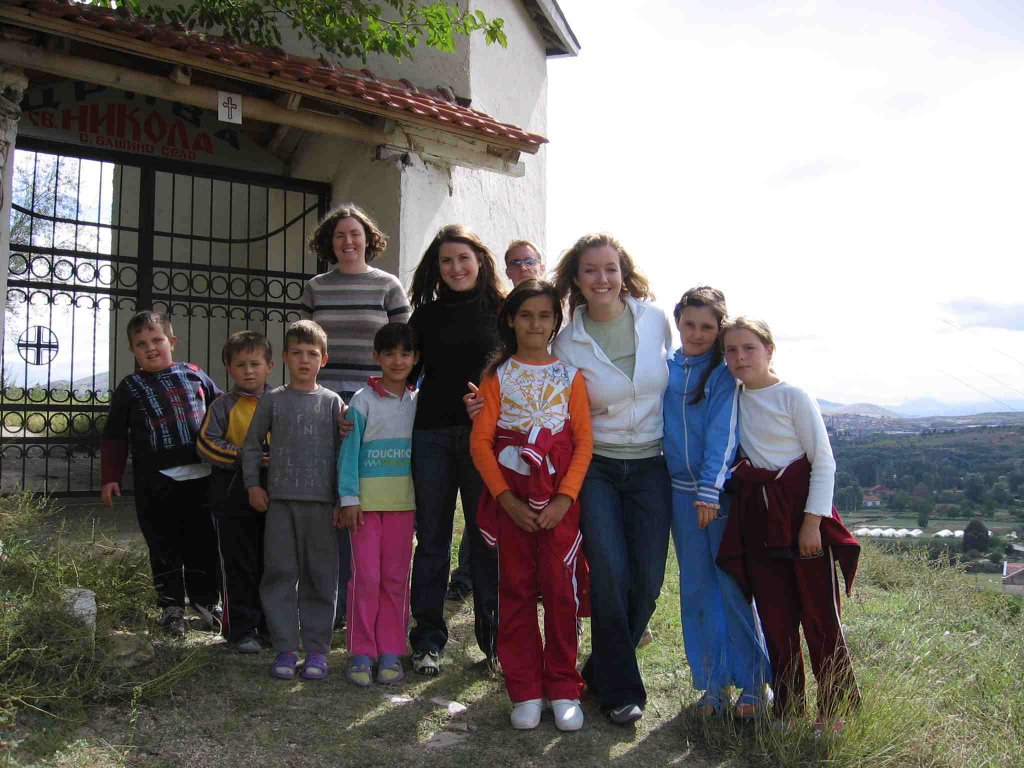
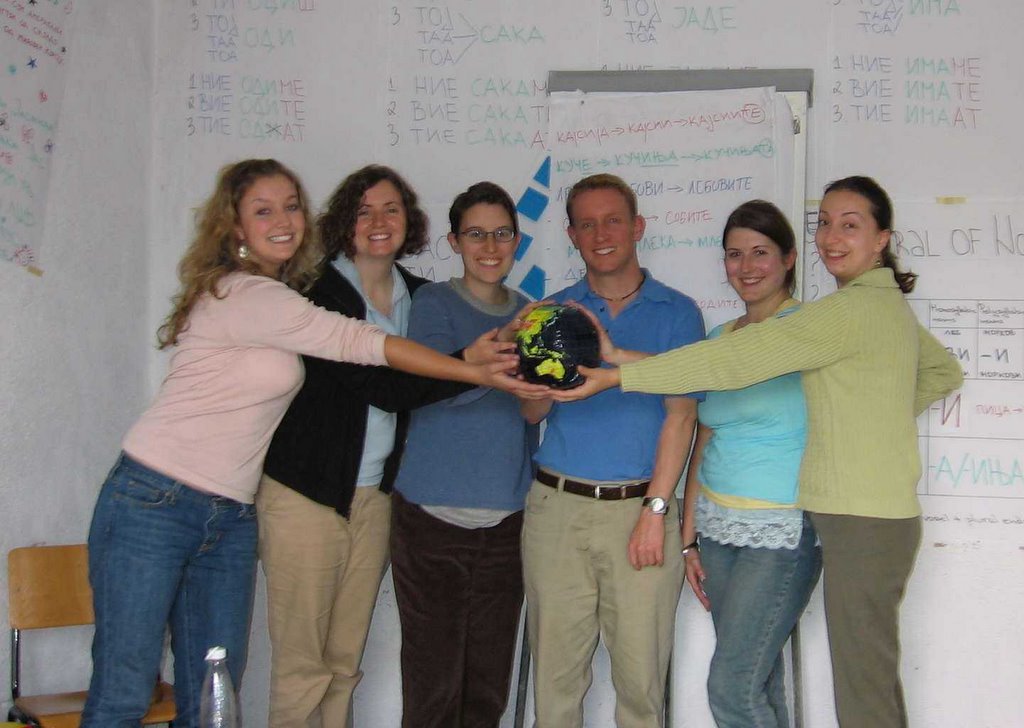
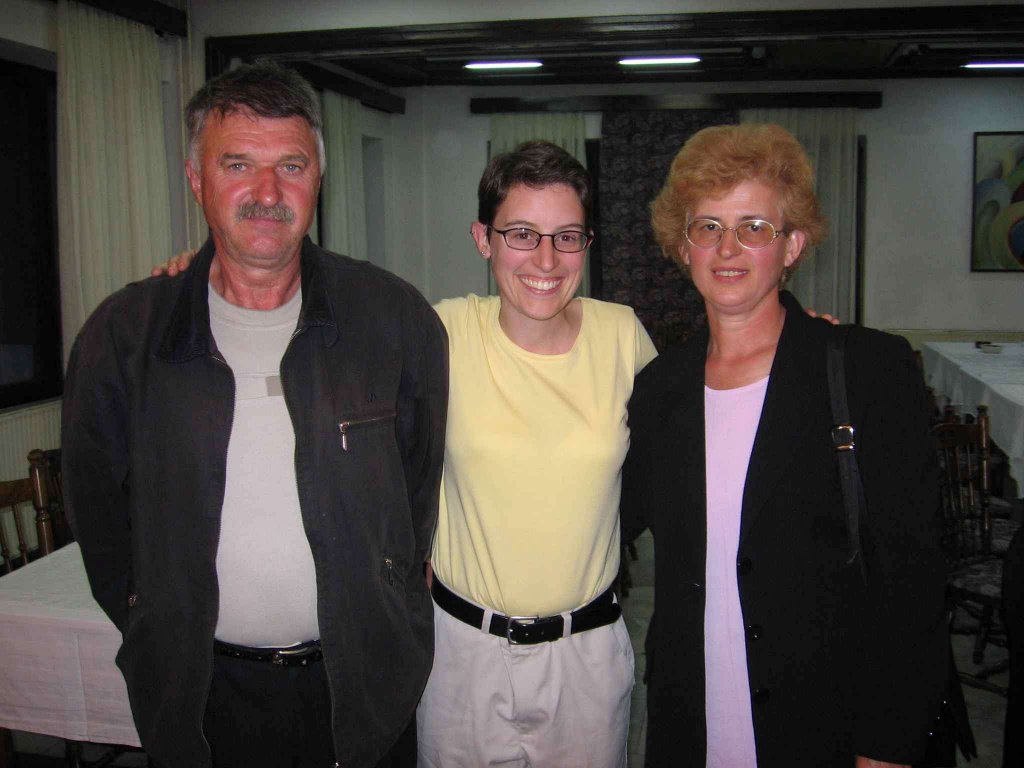
Photos of my host family (mom, dad & grandma), my language class (fellow Peace Corps Trainees in my village and Language Teacher) and a bunch of us in front of the local church.

Monday, October 31, 2005

Traditional Macedonian Costume


Image from the web: http://www.ethnicdance.net/ethnicmusic.html

This is only ONE KIND of traditional Macedonian costume, but it is indicative of what they look like. Each village and community (and other smaller ethnic groups, such as the Albanians) have there own costume, with different kinds and colors. Cool huh?

Happy Halloween!

Mac 10 had a Halloween Party that I organized. No one had made any definite plans, so I decided that someone had to just do it. I tried to get some input from the others and then announced that we would meet at a local bar in Veles at 7:30pm on Saturday night. I encouraged people to bring something scary, as well as chocolate and candy and that there would be a prize for the scariest thing. I also shared some of my Reese’s Peanut Butter Cups. Dennis brought himself, as a Republican, which was pretty funny. Several of the PCT’s in Veles made carved gourds jack-o-lanterns, since they don’t exactly have pumpkins here. They were really well made. But what took the cake was Luke’s video on his digital camera. That day, several groups had visited other communities of fellow PCT’s. Our group in our village hosted the group from another nearby town. Two other groups had visited each other that day and it just so happened that a family picked that day to slaughter their large pig. So several in the group watched it and Luke videoed it on his digital camera. When I watched the video I felt nauseous. I don’t think I could’ve watched it if I could’ve heard the sound over the loud music at the bar. The video was pretty disturbing and he got the popular vote for first place (but was nice enough to share the prize of chocolate candies with everyone).

Other than us crazy ex-pat Americans, Halloween is not celebrated in Macedonia.

Wednesday, October 26, 2005

One down, twenty-six to go!

It's hard to believe that I've now been in Macedonia one month exactly. So much has happened in such a short time. It's also incredible to think of how much of the language I've aquired in this time, although I still struggle to have anything other than really basic conversations and I still am the slowest in my advanced class!

Today was one of my practicum days, when I go into Veles to go to the elementary school and work with a Macedonian English teacher. I've finally realized why I do not exactly get excited about or look forward to my practicum teaching days. I have no idea what is going to happen before I go to these classes. Being unprepared, especially for teaching, goes against every teaching experience I've ever had and is something that I detest. The reason for this is that my practicum teacher (who I like on a personal level) gives me little to no direction on what I am supposed to do in these lessons. Today turned out to be "ask Jesse whatever you want to" for the students, which was very amusing and funny, and I didn't mind, for the most part.

I will say that kids are kids are kids everywhere.

But the same is definately NOT true for schools and teachers.

Today my teacher whacked one of the kids on the head (I missed what he was doing, I'm sure he was misbehaving). And yesterday I witnessed a physical fight in the hallways. Despite several teachers and lots of kids witnessing it, and the teachers yelling at them to stop and making a half hearted attempt to split them up, there were no consequences for the two who were fighting, which blows me away!

The kids today were curious about what America and Seattle are like and what kinds of things I am interested in, like music, food, hobbies, etc. They wanted to know what the nightlife in America is like and what my impressions of Macedonia are, as well as if I have a car and a boyfriend. They asked what the curfew for young people in America is. They asked me what sports I like, if I like french fries, who my favorite actor is, what kinds of clothes I like to wear and not wear and how old I am. They asked how many US states I've been to and what the prices are in America.

I have a site placement interview on October 31st. This is in regard to where I'll be placed for my 2 years of service. They'll be asking me questions about what kind of location I'd like to be in and the kind of work I want to do. I'll ask them lots of questions regarding this particular assignment of teaching homeless Roma youth near Skopje. The more I think about it, the more I am interested, even if it is not everything I want. It may be a very difficult, frustrating experience, but then I didn't join the Peace Corps so that everything would be nice and easy and simple.

Thursday, October 20, 2005

A possible prospect assignment

This afternoon I met with some Peace Corps staff and learned of an interesting possible assignment. It is rare to learn of specific assignments before placement interviews (which don't take place until October 31st), it is like classified information about where and what specific assignments are available. However, from word of mouth and talking with PC staff I had heard a few things. For example, that there are no TEFL placements this year in Skopje or Veles (which disappointed me because I'd been thinking that I'd like to be in one of those sites).

When I mentioned that I'm interested in working with street youth as a secondary project (TEFL being my primary one), I learned about a placement that really piqued my interest. There is a placement for teaching at a school for street kids. I know that this would be a very difficult assignment. It is working with the Roma population, who are an ethnic group where the people are, generally speaking, poor and disadvantaged. I also know that the location would be a suburb of Skopje, the capital (pop approx 600,000), which would also have it's advantages. I don't have any other specifics, I'll have to wait until our site placement interviews. This really sounds like something up my alley, something that I would really like to do.

So, I'm very jazzed right now about this prospect, it is going to be difficult not to get my hopes up too high. Besides, the Peace Corps has already been teaching me all about expectations...so far, with my track record, most of my expectations have been challenged. For example, I was originally nominated for Asia. So I had 9 months of expectations that I'd go to Asia, and hopes of going to China or Thailand. I was also nominated to leave in June. Instead I was sent to Eastern Europe (Macedonia), and left in September. I had also had hopes of being in Veles for training, instead I got a little village, but fortunately it is nearby to the town. Fortunately, it has all worked out for the best and I have no resentments about all of it now. But it really is a reminder to me not to future trip, which I'm so good at doing! :p

Oh, and by the way, it appears as though I may have been able to adjust my schedule so that I don't have to teach at 7:30am anymore (I hope). Regardless of the time, fortunately I only have student teaching twice a week, and the schedule switches week to week whether it is morning or afternoon. Kind of strange huh?

Tuesday, October 18, 2005

An Unusual Americanka

My weekend was good but it went by too fast. Some of the other volunteers and myself went on a little hike on Saturday, we walked up the nearby "mountain" (large hill) that our village huddles next to. It was soooo nice to get out of the village, get a little break, some fresh air and sun and everything. One of my favorite moments was when I discovered a praying mantis and was able to pick it up and get some photos of it. I've explained to my host family and other locals that it is unusual for American girls to like insects and frogs like I do. I wanted to explain that because it seems that a lot of what we volunteers do and how we are is interpreted to represent all of the US. My host grandmother thought that since I do not eat much bread that all Americans do not like to eat bread.

I just finished my second day at the local elementary school. Other than having to be there at the awful hour of 7:30am, it is all good. I am hoping that I will not have to go to the school that early on a regular basis, but it doesn't look promising. I have to get up at 6:30am in order to get a taxi there on time. And as many of you know, I am not a morning person!

The other thing that my family thinks is strange is that I do not like to drink whole milk with a dallop of honey in it, yet I'll add sugar to my yogurt (since it is plain and soupy). They don't understand why us volunteers don't like the cheese, why we want to spend time alone or why we don't feel the need to spend the entire day having "nagosti"; hanging out having tea and goodies at each others houses.

I've also had to tell my family and locals that I am unusual in the amount of traveling I've done. Even amongst the other PC volunteers, I've been surprised to find out that I really am a kind of freak about traveling. I know it's not that common for Americans to travel as much as I have. And I'm not trying to boast here, I feel a little self conscious about it.

I also am probably driving my host mom crazy because I don't give myself a full half-hour to eat breakfast and she thinks I'm going to get sick because I don't dry my hair after a shower (one of the advantages to having short hair).

Well, this can all be politely chuckled about and that is fine. My family is really sweet. The other day I also was able to watch a football (soccer) match on TV with my host brother. Oh, that's another thing, an americanka interested in sports? I think my host brother and dad can adjust to that just fine.

Friday, October 14, 2005

An Afterthought about the PC

Another thought about the Peace Corps.

I've talked to a few fellow trainees about the Peace Corps and they reminded me of a few things that I'd forgotten to mention in a former post...

The PC program only goes to countries where it is *invited* to work in. The countries themselves request that PC volunteers come assist them in certain areas, usually education, business, health, environment and agriculture. At that point, before volunteers are sent over, the PC Staff will meet with the government officials to find out the best way for PCV human resources to be best utilized and helpful to that country.

Peace Corps works with local people in the communities, so it is starting from a grass roots level. Each PC volunteer has a counterpart, a Host Country National, that they collaborate with, so it is a team effort for things to be worked on and improved together.

Peace Corps provides cross cultural training, so that we, as volunteers can collaborate with the locals with a sensitivity to the cultural differences that occur, often on a subtle or invisible level.

It can be argued, at times, that local people can be trained to do the same job that a PC volunteer does. If I felt that were true in my case, then I would see if there is another way that I can be useful because I don't want to put a local person out of a job, especially since unemployment is very high in Macedonia. However, being a native English speaker is not something a local person can provide. In fact, when I met with my teacher today, she asked a few questions about saying some phrases in English and receptive to working with me, which I am really grateful for.

Adjusting to the adjustments

Milomeay!
I met my Macedonian teacher today, the one that I will be working with. She is the same age as I am and she is a good teacher. I like her and her classes a lot and I feel so much more at ease about my student teaching. It turns out that she teaches middle school, which at first I wasn't crazy about (6th, 7th & 8th), however, the good thing is that they have a couple of years of English under their belt. And since I'm really limited in my Macedonian, that will make it easier for me to communicate with and to teach. The kids are fascinated with us, we are probably the first Americans they have ever seen in real life.

Now it is the weekend (yay!) I am ready for a break. Even though I've been here for 2 weeks I feel like I've been here for about 2 months. I think it is because my days are jammed pack.

Every day I have 4 hours of Macedonian language lessons with the 4 other volunteers in my village. Then twice a week we'll go to Veles for our student teaching practicm. Then at least once a week, sometimes twice we'll have Peace Corps meetings (either TEFL training or medical meetings, cross cultural meetings or something like that). And then perhaps I'll have some private tutorage for Macedonian so I can keep up with my advanced classmates! That doesn't leave me much spare time! When I do have spare time I like to go on walks with my fellow trainees in my village (which we're really limited with since the village is pretty small and often have an entourage of little kids following us everywhere), or go into Veles for internet and/or socializing.

I feel tired a lot. I'd been wondering why. Then recently I was reminded...it takes a lot of energy to adjust to everything that we've been having to adjust to! A new country, a new language, a loss of language (English), pre-service training, settling in, living with a new family, a new culture, a new job, the food, the weather, doing without the familiar comforts of home, culture shock, a loss of routine, spending time alone, not having as much privacy or independence, etc etc.

Also, yesterday, I bought my first CD of a Macedonian pop singer. It turned out to be slightly cheesy and overall, pretty good. Today I got my second, one of the most popular Macedonian singers "Toshe", who is incredibly cheesy and pretty good. The best thing about it is that both CD's have lyrics, so it will help me to learn Macedonian. As some of you know, I really got into Latino music when I was in Ecuador, and I fully expect that I'll do the same here. The music in other countries can be cheesy, but I enjoy it. The cheesier, the better! Music is one of my favorite components of other cultures.

Wednesday, October 12, 2005

Feeling like the Christmas Goose

Well, time is trodding along and overall things are going well. Everyday I have 4 hours of language lessons. Then sometimes we have Peace Corps meetings in Veles in the afternoon. Like today, we came into town for medical meeting where we got the rest of our vaccinations. I thought I wouldn't have to get any, but as a precaution the PC gave me a tetnus booster and Polio (which I got once as a little kid, now I should be good for life). Two shots, one in each arm. Now both my arms are sore. Oh well.

The language lessons are with the other PC volunteers in my village (there are 5 of us). My school is just next to my house, since I live off of the village square. I like my teacher a lot. The problem with my class is that as a class we are really advanced. But I'm not advanced. I'm just normal. So compared to my classmates I'm the slowest one. Well, I'm tired of being in an advanced class, I want to be in a normal class now. But that's not an option. I will probably opt to have some private tutorage with my teacher once or twice a week. At least it's free.

As for my host family, they are very sweet, but they overfeed me. I've been joking with the other PC volunteers that I think my family is trying to fatten me up for Christmas. I feel like the Christmas Goose! And then yesterday they actually weighed me! They brought me back to a storeroom where there was an old scale and they had me stand on one side while they added metal gram boxes. I know it is true that they want to fatten me up. They think that I'm just being polite when I tell them I'm full. I know that this is a common issue and it is one of the cultural differences between the US and Eastern Europe.

But I'm not having as many issues with my host families as some of the others. Some of the other host families don't give the volunteers any privacy or free time. Some of the volunteers in the Albanian community aren't getting fed very much. One gal in our village had her host grandfather pass away yesterday! The family is now all in mourning, it is really tough.

Tomorrow we start our student teaching, we are all at schools in Veles. We'll all be paired up with a local elementary teacher. I'm a little nervous, but with the way things have been going, it will probably be fine.

Last weekend one of the relatives visited and she is about my age and speaks very good English. Her name is Vane (prounounced "Van-aye"). We spent some time hanging out, she did a lot of translating. We went to the family's garden and then to their summer house on the lake. We got along really well. She is a student in Skopje. She has invited me to visit her. I am so glad to have made my first Macedonian friend!

Now I'm off to go find a CD store nearby so that I can discover the best of local Macedonian music!

Friday, October 07, 2005

Photos We've All Been Waiting For!


A local near my village.

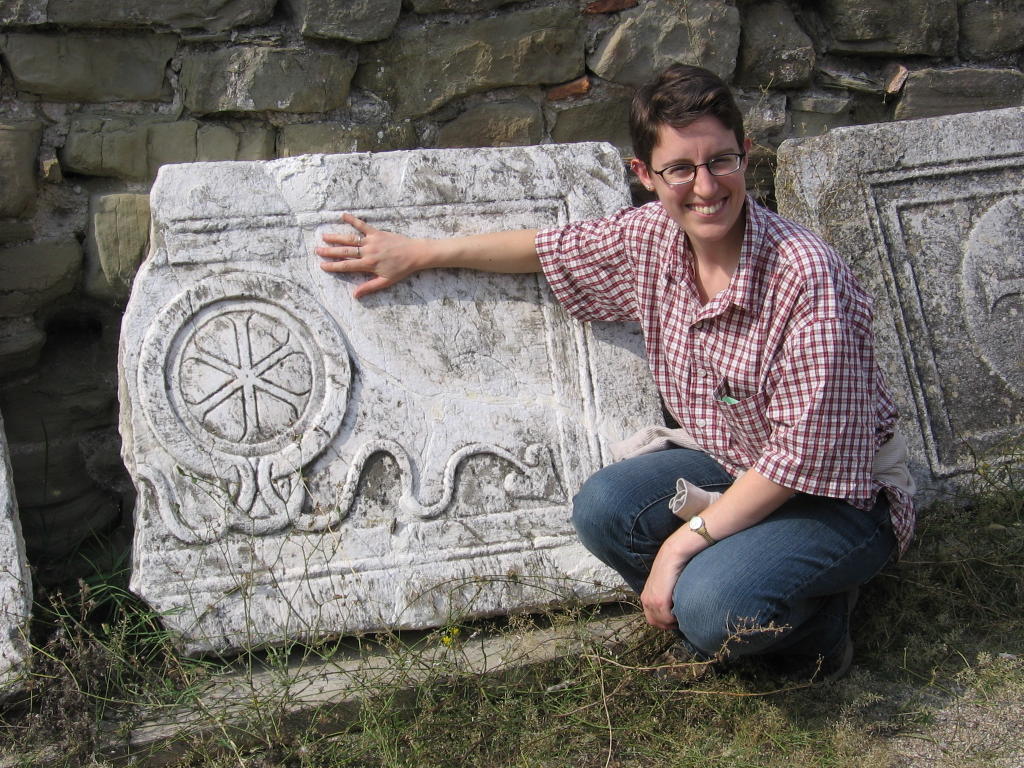
Jesse at Stobi, a nearby archeological site, about 2000 years old.

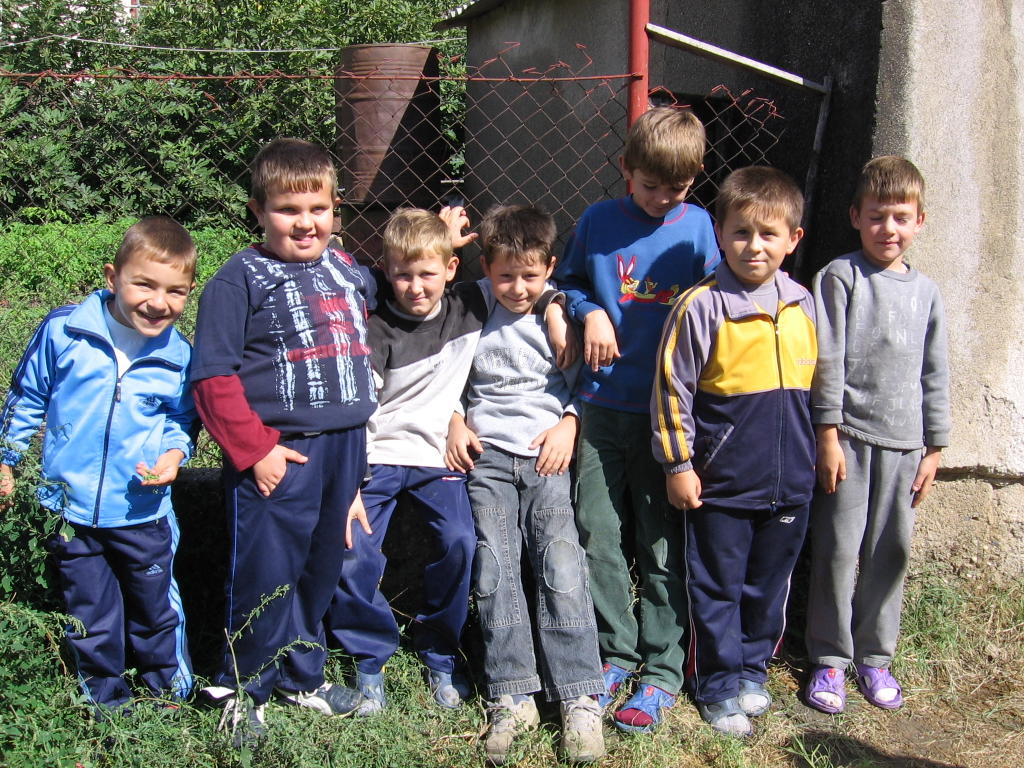
Some members of the "fan club".

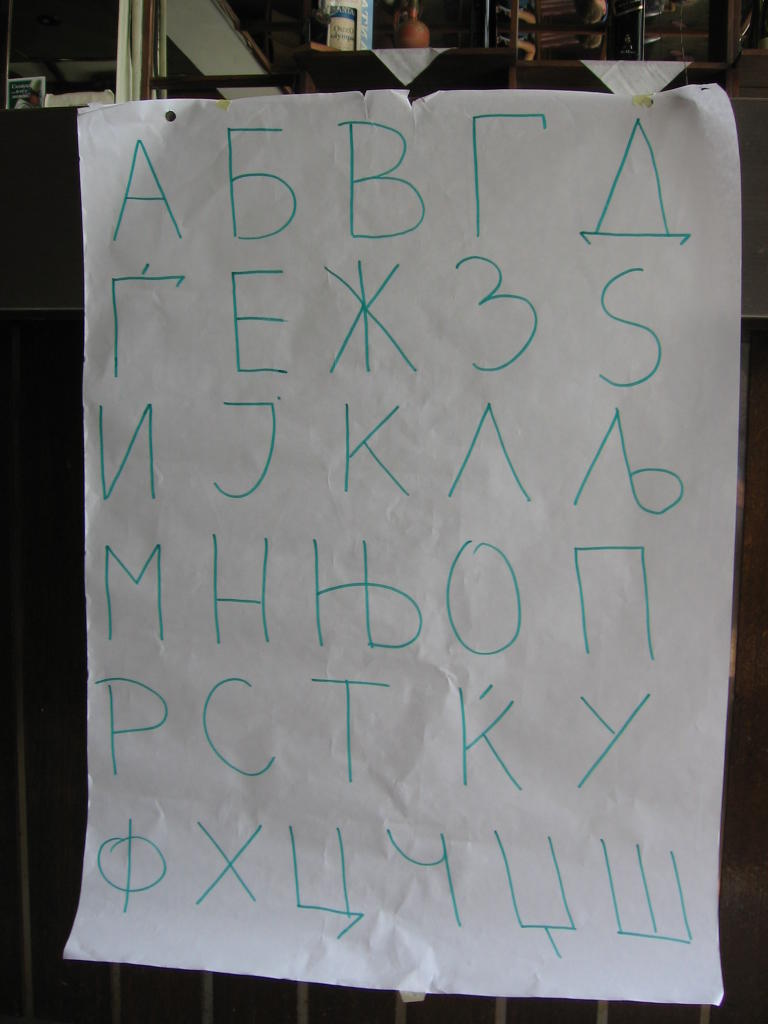
The Macedonian Alphabet.

The city of Veles with the Vardar River, view from our hotel.

Monday, October 03, 2005

My Brother is a Brat

Learning Macedonian is very interesting. The language is very unique, using a Cyrillic alphabet (and not latin based, as Spanish is). However, there are words that are similar to English or Spanish. For example, the word for "table" is "masa". The word for "brother" is "brat". The word for "dog" is "koo-chay" (which sounds a lot like one of my best friend's dog's name). The word for "small" is "malo", where the word "malo" means 'bad' in Spanish!

Although I'm not the fastest learner, I do enjoy learning other languages. I like the way the words are pronounced and roll off your tongue. Macedonian also has a rolled "r" like in Spanish. Writing it is also proving a challenge (however, learning Macedonian is not as hard as Chinese would be! As some of you know, I was originally nominated for Asia! And I learned that indeed, had I been medically cleared in time, I would have gone to teach at a university in China--I met my original Placement Officer in DC). Nevertheless, I am now very glad to be in Macedonia, learning their language.

Oh, and have I mentioned that they have Turkish toilets here? Thank goodness my host family has a western toilet, but in restaurants and in my school where I have 4 hours of language lessons every day, there is a turkish toilet (just do a google search of images to see what one looks like). And when I was in Ecuador I quickly learned that the plumbing system cannot cope with toilet paper and so therefore, the paper goes in a bin next to the toilet...well, it is the same here!

Different Schools of Fish

There are different schools of thought about the Peace Corps and what it does. Just like there are different ideas about how useful or appropriate it is for people around the world to learn English. I struggled with whether or not I wanted to become part of the US government when I personally have issues with it's foreign policy. I also struggled with the idea of teaching people in Ecuador and other countries English. I don't rejoice at the idea that English is becoming the universal language. However, that is beyond my control. What I concluded is that, while I do not believe that American culture is better than other cultures, the reality is that by learning English, people can better their lives, for example, get a better job. That is the reality, right or wrong.

Also, from my experiences in other countries and cultures, I know that to understand another culture you have to experience it to really appreciate it. There is the well known idea that you can give a man a fish or you can teach him how to fish. The Peace Corps goal is to teach him how to fish.

"In 1961, President John F. Kennedy established the Peace Corps to promote world peace and friendship. Three simple goals comprise the Peace Corps' mission:

1. Helping the people of interested countries in meeting their needs for trained men and women.
2. Helping promote a better understanding of Americans on the part of the peoples served.
3. Helping promote a better understanding of other peoples on the part of all Americans."

While I don't believe that the PC is perfect or infallable I do believe that it makes a positive difference. For example, countries that the PC used to go to 20 years ago, for example, Chile, have become self sufficient to the point that PCV's don't need to go there anymore (which, of course, is also argueable, but from actually traveling to Chile and other countries such as Bolivia, I can say from what I saw with my own eyes that a country like Bolivia has a greater need for PCV's right now than Chile).

So, what I am doing in Macedonia right now is learning the language and culture. I would not have this opportunity if it wasn't for the PC. And how many of you would be learning about Macedonia if it were not for my experience here now?

I don't believe that I'm going to change the world. I don't have unrealistic goals of what the PC can do. In fact, I think that I have more to learn than what I have to teach.

The teacher becomes the student. And I am eager to learn.

Sunday, October 02, 2005

My Host Family

Things continue to go well for me and I am very greatful. Friday they announced what community we would be spending our training living with a host family. There are about 5 communities in and around Veles, with one group in Veles. One community is Albanian (and Muslim), some towns are about a half hour drive away. I got a nearby town, it is like a small village very close to Veles, but the citizens don't like to be called a village, they say they are a suburb of Veles. I was disappointed at first because I wanted Veles, I didn't want a small town. After language class our group took a field trip to a nearby acheological site called Stobi. It was cool. That evening was the welcoming ceremony where we met our host families. My fellow trainees joked about it being "Free American Day. Take an American home with you. It even has all it's shots!" (immunizations)

I met my host mom Pala and my host dad Dime (dee-may). They had traditional dancing that we also joined in with. Then we packed up all our stuff and were taken home. I met my host grandma "Baba Booba", she is Dime's mother and is absolutely adorable. After they helped me take my stuff to my room the first thing they wanted to know was how old I am. As I was escorted downstairs I saw a few kids standing outside the gate and they said "What's your name?". They stood around and giggled as I answered. I thought of them as a fan club. As I sat in the kitchen some of the braver boys crept up the driveway and peeked in the doorway and repeated "What's your name?" I giggled and Pala shooed them away. Pala and Dime have two sons, both in their 20's. One of them, Loopche, now lives in Holland. The other one is named Kyrie and he is about 27. I think Pala and Booba really like having a girl around. I am really well taken care of, even babied. Plus with the language barrier I spend a lot of time smiling and shrugging my shoulders, so I really feel like a little kid.

I have my own bedroom. All the bedrooms are upstairs, the kitchen is downstairs and so is the bathroom. My only complaint is that I have to go outside to get to the bathroom. It was also raining all day Saturday, so we spend the day with our host families. It was like a day-long language lesson. My family is very sweet, they don't speak much English, but that's what I prefer anyway. Today (Sunday) we got to get a tour of our little town. The fan club was soon in tow. The kids are sooooooo cute and I learned that it is common in this culture for the kids to be overindulged. My family also owns a store that is downstairs, so the family members are often around during the day.

Tomorrow we'll start formal language lessons in town. I also know that we will have a practicum student teaching assignment that will be in Veles, so at least I know I'll be going into Veles often enough to have some internet access (like today).

Thank you all for your e-mails and keeping me up to date on your neck of the woods. I miss you all very much. I still can't believe I'm in Macedonia in the Peace Corps!!!!

(I'll also try to post some photos very soon!)